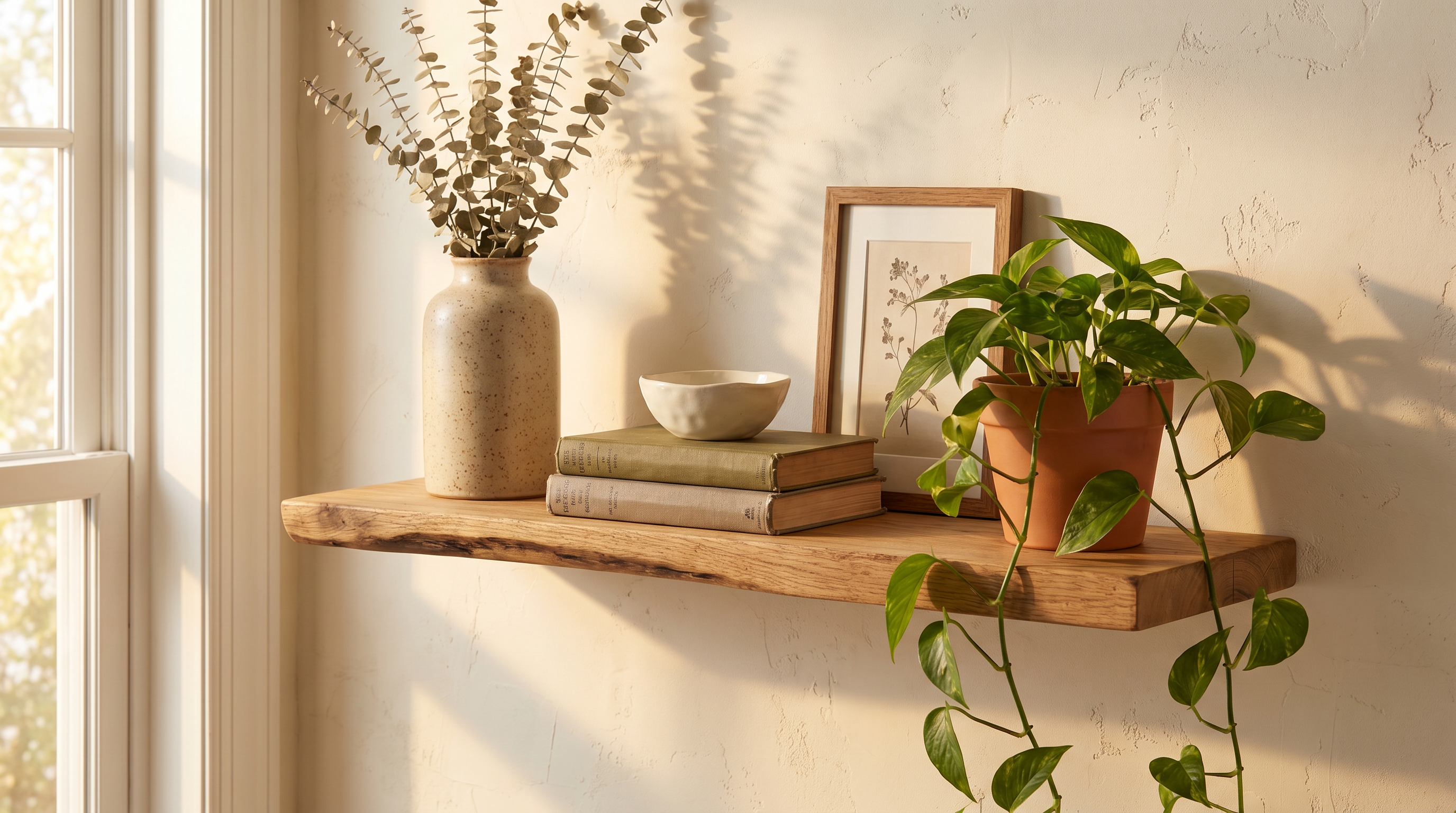
How to Style Floating Shelves Like a Designer (Without the Cluttered Look)
Floating shelves promise the perfect balance of storage and style — until you’re standing in front of empty wood planks with a candle, two books, and no idea what to do next. The good news: well-styled shelves aren’t about owning the right things. They’re about a handful of simple rules that designers use every single time. Here’s how to style floating shelves so they look intentional, layered, and warm — not cluttered, not bare.
Thank you for reading this post, don’t forget to subscribe!
Start with the Right Foundation
Before you place a single object, the shelf itself sets the tone. In 2026, the look is moving away from thin, stark white shelves toward warmer, thicker, character-rich wood. A handcrafted shelf brings grain, texture, and a natural focal point that mass-produced options can’t match.
Choose wood that adds warmth
Solid acacia, walnut tones, and live-edge profiles ground a wall the way a good piece of art does. If your space leans neutral or modern, a warm wood shelf adds the contrast that makes the room feel finished. Browse our handcrafted bathroom shelves for examples of profiles that work in any room — not just the bathroom.
Mind the mounting
True floating shelves have no visible brackets. That clean line is half the magic. If your shelves came with exposed hardware, swap them out before you style — no amount of decor will hide a clunky bracket.
Use the Rule of Three (and the Power of Odd Numbers)
Designers almost never group items in even numbers. Pairs feel formal and static. Groups of three, five, or seven feel collected and natural. This is the single fastest fix when a shelf looks “off.”
Build vignettes, not rows
Instead of lining items up like soldiers, cluster them into small groupings of three. A tall vase, a stack of books, and a small sculptural object form one vignette. Leave breathing room, then start the next.
Vary the heights
Three objects at the same height is a fence. Three objects at different heights is a composition. Use stacked books as a riser to lift smaller pieces — a small bowl on top of two coffee table books instantly looks more intentional.
Mix Materials, Textures, and Scale
The shelves that feel collected and timeless almost always mix four or five different textures. This is what gives them depth.
Aim for at least three textures per shelf
Think wood, ceramic, glass, woven fiber, metal, or stone. A glossy ceramic vase next to a matte stoneware bowl next to a stack of linen-covered books reads as layered. Three matte ceramics in a row reads as flat.
Let one piece be the hero
Every shelf needs a focal point — one object slightly larger or more sculptural than the rest. A handcrafted wooden bowl, an oversized vase, or a small piece of art on a ledge. Build the rest of the styling around it.
Don’t forget functional beauty
In a kitchen, a beautiful cutting board leaning against the wall is both useful and decorative. Our long acacia cutting board with handle doubles as a serving piece and a styling moment when displayed upright. The same goes for a California epoxy cutting board — the resin catches light and becomes a small piece of art.
Layer with Books, Plants, and Personal Pieces
The three building blocks of a styled shelf are books, organic elements, and personal objects. Get those three working together and almost any combination looks good.
Books do the heavy lifting
Stack them horizontally to create platforms. Stand them vertically as anchors. Mix both on the same shelf. Designers often turn books backward (spine facing the wall) to keep the color palette clean — controversial, but it works in a minimalist space.
Add something living
One plant per shelf, minimum. A trailing pothos softens hard edges. A small olive branch in a stoneware vase adds height. If you don’t trust yourself with plants, dried eucalyptus or pampas grass works beautifully and lasts for years.
Make it personal
The shelves that feel like a home — not a showroom — always include something the owner loves. A travel souvenir, a handmade ceramic from a local artist, a vintage frame. One personal piece per shelf keeps it from feeling staged.
Don’t Be Afraid of Negative Space
The biggest mistake in shelf styling is filling every inch. Empty space isn’t wasted space — it’s what lets the eye rest and the styled pieces shine.
The 60% rule
Aim to fill about 60% of each shelf, leaving roughly 40% as negative space. This ratio reads as curated rather than crammed. If your shelf feels busy, remove one item. Then remove one more.
Stagger across multiple shelves
If you have two or three shelves stacked vertically, don’t fill them identically. Imagine an “X” across them: place taller items on the upper left and lower right, smaller groupings opposite. This asymmetry creates visual flow.
Style by Room (Quick Cheat Sheet)
Bathroom shelves
Roll up three hand towels and stack them on the bottom shelf. Add a small vase with greenery, a candle, and a clear apothecary jar of cotton rounds. Our farmhouse bathroom shelf and handmade rope shelf are designed exactly for this — warmth, function, and spa-like calm in one piece.
Kitchen shelves
Stoneware mugs, a few cookbooks, a small potted herb, and a beautiful cutting board leaning upright. Keep the color palette tight — three tones max — for that bistro look.
Living room shelves
Larger art books, a sculptural object or two, framed photos in matching wood tones, and one trailing plant. This is the room where personality should win — display the things you actually love.
Entryway shelves
A small wooden tray for keys, a stack of design magazines, a candle, and one piece of art leaning against the wall. Functional plus welcoming.
The Final Test
Step back ten feet. Take a photo on your phone. Look at it. The camera flattens everything and reveals what your eyes miss in person — gaps, clusters, awkward heights. If anything feels off in the photo, adjust one item at a time and shoot again. Three rounds is usually all it takes.
Beautifully styled shelves don’t require a designer’s budget — they require warm materials, a few good rules, and the patience to edit. Start with a shelf you love, layer in pieces with story and texture, and leave room for the eye to breathe. If you’re still hunting for that hero piece, our best sellers are a good place to begin — every one is handcrafted in California to add the kind of warmth no mass-produced shelf decor ever quite manages.
